Well, hello there. I am late on last week’s post and have much to catch up on since. But before I go any further, I thought it would be good to shed some more light on what exactly TMS is. So, this post is going to be a bit drier than the rest, but hopefully it illuminates anything about this treatment that I’ve only vaguely glossed over in previous posts 🙂
What is TMS?
Essentially, TMS is a noninvasive treatment used to treat depression and anxiety when other modes of treatment have been unsuccessful. It works by using magnetic fields to stimulate nerve cells in the brain through an electromagnetic coil. Unlike electroconvulsive therapy, it does not require sedation.
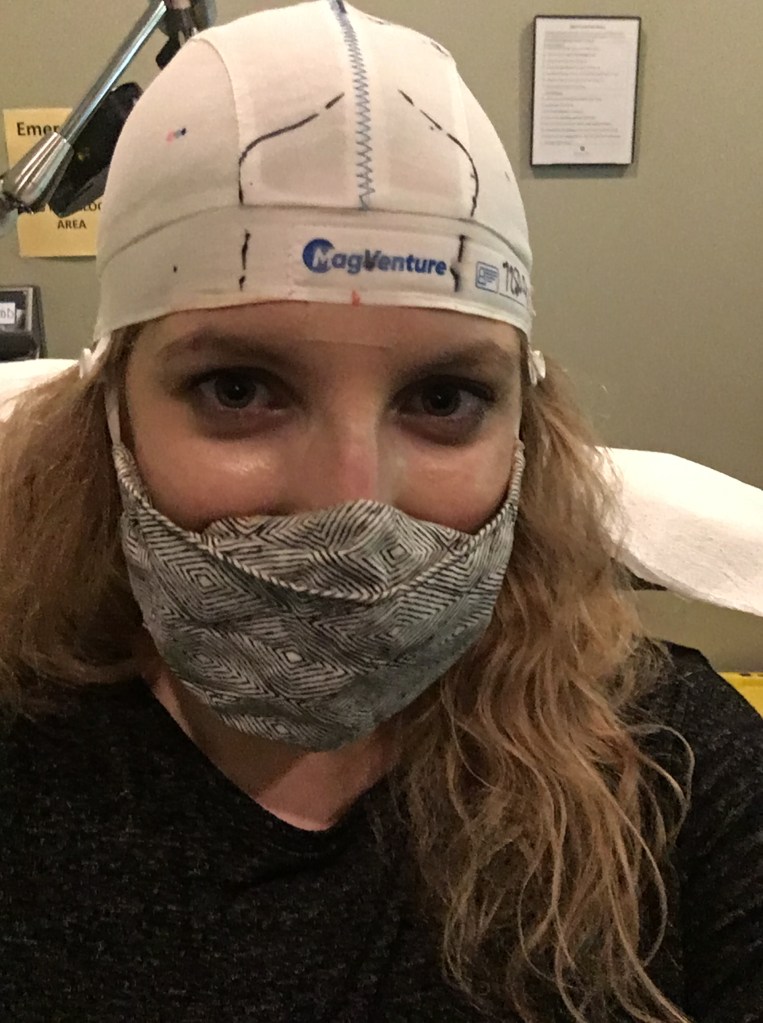
The electromagnet sends a series of magnetic pulses into areas of the brain that are thought to regulate mood. I’ve also heard it likened to a “reboot” of the brain (1).
How does TMS work?
The first TMS session involves a “mapping” of the brain. Essentially, I put on a very tight cap (like a swim cap), and the coil was placed against my head. The first session is called mapping because the doctor is trying to find the motor threshold, or, the ideal level of stimulation.
He placed the coil at different points along my head at varying levels of intensity. At certain places, this would make my right hand twitch, and it’s the twitching that helps determine the motor threshold.
The magnetic bursts reach two to three centimeters into the brain, into the region known as the salience network, and create small electrical currents. The currents “activate cells within the brain which are thought to release neurotransmitters like serotonin, norepinephrine, and dopamine” (2).
Why try TMS?
TMS is worth exploring if, like me, you’ve tried every medication under the sun and still relapse with anxiety and depression. Frustratingly, it still takes the standard set of four weeks to start to notice a difference in mood.
I am currently on week two and have noticed a slight improvement…but that could also be attributed to daily Yoga With Adriene videos 🙂 Either way, it’s nice to hold onto this little glowing tree star of maybe-things-aren’t-so-bad.

Sources:
- “Transcranial Magnetic Stimulation.” Mayo Clinic. Mayo Foundation for Medical Education and Research, November 27, 2018. https://www.mayoclinic.org/tests-procedures/transcranial-magnetic-stimulation/about/pac-20384625.
- “How Does TMS Work?” Department of Psychiatry, October 12, 2020. https://www.med.unc.edu/psych/patient-care/interventional-psychiatry/tms/how-tms-works/.
 Claire Paschal